
All Change
Welcome back after a long hot summer! The weather of course has been better since the children went back to school. I have also been back in the classroom for more updating lectures on changes in employment law and giving talks to others on the subject. It is always interesting to pass information on, see clients and meet new people so I will keep you posted on future events which I am involved. For now here is an update on some of the many changes in employment law which have recently come into effect.
Registration of Employees
You can’t have missed the press coverage on issues relating to Criminal Record Bureau checks but does it impact on your business? Most businesses affected up to now will be well aware of their responsibilities. However some extra employers and organisation will be affected by the changes. The notes below are a very simplified summary so if you are in any doubt take further advice.
The new system means that
- There will be two new lists kept by the Independent Safeguarding Authority (“ISA”); of people unsuitable for involvement in activities with children and those unsuitable for involvement in activities with vulnerable adults.
- Anyone wanting to be frequently involved with “regulated” or “controlled activities” must register with the ISA who will confirm whether they are on the barred list. Broadly
- “regulated activity” will cover a range of specified activities that provide an opportunity for frequent close contact with children or vulnerable adults or other activities in key settings such as schools and care homes which provide an opportunity for contact. It also includes any fostering or childcare.
- “controlled activity” covers support work in general health settings, further education settings and adult social care settings e.g. cleaners. It also covers work which gives a person the opportunity for access to sensitive records about children and vulnerable adults, including education and social services records.
Individuals will have to pay £64 for registration unless they are volunteers when they can register for free.
- Organisations and employers must not use volunteers or take on employees for
- regulated activities until they have checked they are registered and not barred,
- controlled activities until they have checked they are registered and if they are barred that appropriate safeguards are put in place,
breach of these requirements is a criminal offence by the employer and employee or volunteer.
- The ISA will maintain the lists and keep employers and organisations up to date on changes in status of those they have had checked.
- There will be an appeal system for people listed who object to any bar.
- Employers in regulated or controlled areas must report information when an employee or volunteer poses a risk to vulnerable people or children. Other employers may report relevant information. There are criminal penalties for failing to report where there is an obligation to do so.
These changes are being phased in.
From 12 October 2009
- The new lists will be fully in force.
- Employers’ duty to report issues will be in force.
- There will be criminal penalties for barred individuals who take on or seek work with vulnerable groups and for employers who take them on.
- Employers involved in regulated activities can apply for enhanced CRB checks.
From July 2010
- Employees and volunteers can start to register with the ISA
From November 2010
- Individuals must register and employers and organisations must make checks with the ISA before taking on employees or volunteers for regulated or controlled activities.
From 2011
- Existing employees and volunteers involved with regulated or controlled activities with or without CRB checks must register starting with those with no checks and those with the oldest checks.
Things to do now.
- Assess whether you now need to apply for enhanced CRB checks.
- Assess whether you are obliged to report information about employees or volunteers from October 2009.
- Consider whether your employees or volunteers will need to be registered.
- Put in place procedures to check new employees from November 2010 at the latest. Remember you can’t take someone on and then check them out.
Don’t forget the cost of employment and dismissal went up on 1 October 2009
- The main increases
- Adult rate £5.73 per hour to £5.80 per hour
- Development rate from £4.77 per hour to £4.83 per hour (specific accredited training.
- 16 to 17 year olds rate £3.53 to £3.57 per hour.
- Value of accommodation taken into account £4.46 to £4.51
- And don’t forget employer’s can no longer use tips to top up pay to the national minimum wage.
- Also a week’s pay for calculating certain statutory payments including redundancy payments and unfair dismissal basic awards has risen from £350 to £380.
Length of service on redundancy.
Since the anti age discrimination legislation came in 3 years ago there have been questions about whether employers can take account of long service (where employees tend to be older) when selecting for redundancy. The Court of Appeal have agreed that using such a criteria may be “a proportionate means of achieving a legitimate aim” e.g. keeping necessarily experienced staff creating stability and rewarding loyalty. However it has to be just one criteria among others and isn’t a return to the old simple process of last in first out.
The Lords have Leapt their last
There will be no more reports on cases going to the House of Lords. From 1 October 2009 the judicial work of the House of Lords has been taken over by the new Supreme Court.
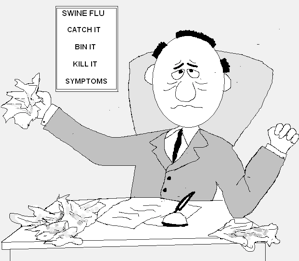
It’s been a swine of a day.
Less has been heard about swine flu over the summer. However there are predications that up to 50% of employees may be off ill over the winter. Also parents may have problems with children off ill or if schools are closed.
Reports suggest most employers have not prepared for these possibilities but what can you do?
Some suggestions include:-
- Additional office cleaning and hygiene requirements e.g. alcohol-based handrubs in toilets and entrances to premises
- Screens to reduce the spread of airborne germs, e.g. in open plan areas
- Signs reminding employees and visitors to use the handrubs etc and discourage those with flu symptoms coming to work.
- Offering some flexibility over hours and working at different offices or home working
Many employers encourage employees with a mild sniffle or sore throat to “buck up” and get on with the job. Whether this is worth it in the middle of a pandemic remains to be seen. Of course some employees may take an extra holiday on the back of the flu problem but good management can discourage such behaviour. I can help with advice on managing absenteeism and referring you to sources of support.
For more advice on swine flu at work try these web sites.
www.businesslink.gov.uk/bdotg/action/detail?type=ONEOFFPAGE&itemId=1083024727
Client Survey – Is there anybody there?
Feedback is always valuable and it also helps us make the newsletter more relevant and interesting for you. At it’s simplest it is good to know whether you have received and looked at any of the newsletter rather than simply deleting it. The easiest way for you to do this is just to respond to the read receipt automatically generated with this e-mail. I look forward to hearing from you.
Did you find the articles interesting? Or if there something else you would like to know about give us a call or e-mail me.
Take care

| Edit 32. This newsletter looks at new cases and employment related matters, which are likely to be of interest to many. However specialist advice should be obtained before taking or refraining from taking action based on comments in this newsletter, which is only intended as a brief note. For more information or if you have specific concerns phone me on 01233 714055 or e-mail kirsten@moon-and-co.co.uk |