Editorial
Thank you for the positive feed-back on our “Summer Special.” This time it’s the normal autumn round-up of some general employment news stories. Some are directly relevant to employment law e.g. wage rises. Others have a slightly different slant; such as the change to consumer rights laws, as these impact on what employees should know where their employer is selling to the public. If there is anything you would like more information about just let us know.
Consumer Rights Act 2015
Whilst this new act isn’t directly related to employment the main parts will apply to businesses and consumers from 1 October 2015 so it pays to be aware of it. Also, if you run a business think about how you will ensure that your employees who deal with consumers and contracts receive the training they may need. The purpose is to replace and simplify a raft of old legislation relating to business to consumer transaction including the Sale of Goods Act 1979 and the Supply of Goods and Services Act 1982. The new act also has more details relating to internet contracts. The idea is to make it easier for the parties to understand what their duties are and how to sort out disputes. Trading Standards have produced a number of guides, set out on its Business Companion website. This news page gives a good overview with a checklist, links to the Consumer Rights Summary (designed to give a clearly explained overview of the key consumer rights) and more detailed guides on different aspects of the new rules.
Minimum Wage and Living Wage
As usual at this time of year the National Minimum Wage increases. From 1 October 2015 its
- £6.70 for those aged 21 and over
- £5.30 for those aged 18 – to 20 years
- £3.87 for those who are above school leaving age but under 18 and
- £3.30. for apprentices under 19 or 19 or over who are in the first year of apprenticeship
Don’t forget a national living wage is being introduced from April 2016. This will be set initially at £7.20 per hour and applies to employees aged 25 and over. There will be changes to corporation tax and national insurance rules which may help offset this additional cost particularly for small businesses.
Self Employed less Safe?
New regulations take some self-employed people out of the realm of the Health Safety at Work Act 1974. It only applies to those who are truly self-employed, have no employees and whose work activities pose no potential risk of harm to others. If the new exemption applies to you it will reduce the amount of paperwork in your business but make sure you are clear whether you are still caught by the rules.
You have to consider whether others, e.g. public, customers, other site users etc. might be at risk. For some it may be obvious but others will need to carry out a risk assessment. Further, some work activities are deemed by law to be so risky that all the Health & Safety obligations automatically continue apply e.g. work in agriculture or with asbestos. For more advice see the Health and Safety Executive notes. The examples it gives about when the exemption applies make interesting reading and may not always be what you expect. Remember you are considering the likelihood of someone else being harmed or injured because of your work activity, not just whether where you work is safe. E.g. someone writing a novel from a home office is probably exempt but someone working in the same room writing a manual for using machinery is still subject to Health and Safety laws.
Whether someone is self-employed is also an issue we often have with clients. They often think the people they have working for them are self-employed so they don’t have to think about tax issues or employee rights. However in many cases these people are employees (or workers who have a lot of the same rights as employees). So don’t just assume that the changes in regulations apply to you or someone who provides services to you.
And remember even with efforts to simplify the law there are lots of overlaps. When I write an employment policy about appearance and wearing personal protection equipment I include a note that employees should talk to employers if there is a problem with complying. It isn’t practical to list in the policy all the possible exceptions that might apply. For example there are new regulations expanding the situations where Sikhs don’t have to wear safety helmets. However specific advice needs to be taken in each case to ensure both an employee’s safety and their legal rights.
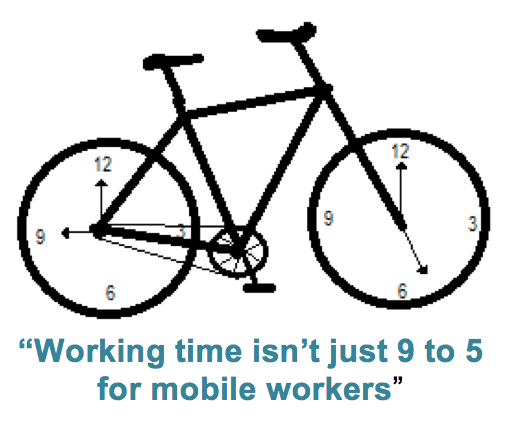
Time on the road
When is time, working time (for the purposes of the Working Time Regulations and National Minimum Wage rules)? Some employers are always looking to find ways of getting employees to do more for less and this impacts on not only their employees but other employers who play by the rules.
An important new case deals with employees who are mobile, e.g. don’t provide services at the employer’s premises but travel to clients or customers’ homes or businesses. The UK government guidance states that travel to and from a fixed place of work is not working time but travelling for work, is working time, a classic example would be a domiciliary care worker travelling between clients’ homes.
The new case considered by the ECJ involved Spanish workers who install security equipment. Apart from a weekly journey to the office to pick up supplies and tools they travel between home and customers’ premises. The employer claimed that the time travelling from home to the first customer and back home at the end of a day was not working time. The ECJ wasn’t impressed. These employees had no choice in where they went or the time it took, whether it was from home to customers or between customers and they had no fixed place of work. From the working time point of view this means employees may hit the maximum 48 hour week earlier and it could impact on weekly and other break entitlements.
The UK government expressed concern that this could lead to higher wages but the ECJ rejected this on the basis that employers can specify the rate for travelling time. Whilst for many this may be the case for some the effect of the national minimum wage (and later the national living wage) will add to some employers’ costs. It has even been suggested that if employees are not specifically paid for this time they may argue that such time is overtime and so any terms relating to overtime pay will apply.
AND with all that travel remember about smoking in cars.
It is now illegal to smoke in a car where there is someone under 18. Not generally a work issue as smoking in cars for work purposes is generally banned unless the employee is in their own vehicle and on their own. However, if an employee has the right to use a car for personal purposes it may be worth reminding them that smoking with children in the car is now banned. Check whether your insurer wants the point covered; this may be relevant even if your smoking policy bans smoking wherever it is illegal.
A couple of exceptions to the new law (though an employer’s smoking policy may be more restrictive), it doesn’t apply to:
- e-cigarettes (vaping) (employers may want to introduce a policy about this)
- a driver who is 17 years old if they are on their own in the car
- a convertible car with the roof completely down
Occupational Therapy for Employees
The new “Fit for Work” support service is now available. This system is designed to help working people with long-term illness problems return to work more quickly. GPs in England and employers can now make referrals to the new service. It is designed to help where people are, or are likely to be, off work for more than four weeks. Where employers have their own occupational health service process this won’t replace it, but most small employers don’t. Therefore, although it is voluntary, this may help both employers and employees resolve some of the issues relating to more serious health problems.
On referral the employee will have a consultation with an occupational health professional whose role is to look at what might be stopping a return to work. This can include work and non-work matters as well as direct health issues. Then they can set about creating a Return to Work Plan, which can, with the employee’s agreement, include direct liaison with employers to help the process work. This support can last for up to three months and where it’s used can stand in the place of a fit note. The service also provides direct advice and information to employers and employees, through its web site, about various health issues that may affect employees. The main advice hub for this service is here, with information in sections for employers and employees as well as GPs. Generally, in relation to managing long term sickness there is a useful ACAS guide, although as it was produced in March 2014 it doesn’t deal directly with this new service.
Take care,

| Edit 43. This newsletter looks at new cases and employment related matters, which are likely to be of interest to many. However specialist advice should be obtained before taking or refraining from taking action based on comments in this newsletter, which is only intended as a brief note. For more information or if you have specific concerns phone me on 01233 714055 or e-mail.kirsten@moon-and-co.co.uk. To unsubscribe to our newsletters e-mail kirsten@moon-and-co.co.uk |